
BECOMING
Updated: Apr 13
By Tiffany Xiang
Published April 2026
Growing up often means existing in an in-between state. We are no longer children, yet not fully adults. This stage is uncertain, but it is also where identity begins to take shape.
Artistic development follows a similar process. Most artists begin not with originality, but with imitation. Styles are borrowed, techniques are learned, and influences are absorbed. Over time, through repetition and experience, these influences are gradually transformed into something personal. What begins as imitation becomes individual expression.
This process is closely connected to many Eastern artistic traditions. In these contexts, skill is developed through long-term practice, discipline, and repetition rather than sudden inspiration. Artistic identity is not immediate, but constructed over time.
The work of Yoshitomo Nara reflects this idea of becoming through both subject matter and visual language.
Artwork Analysis 1
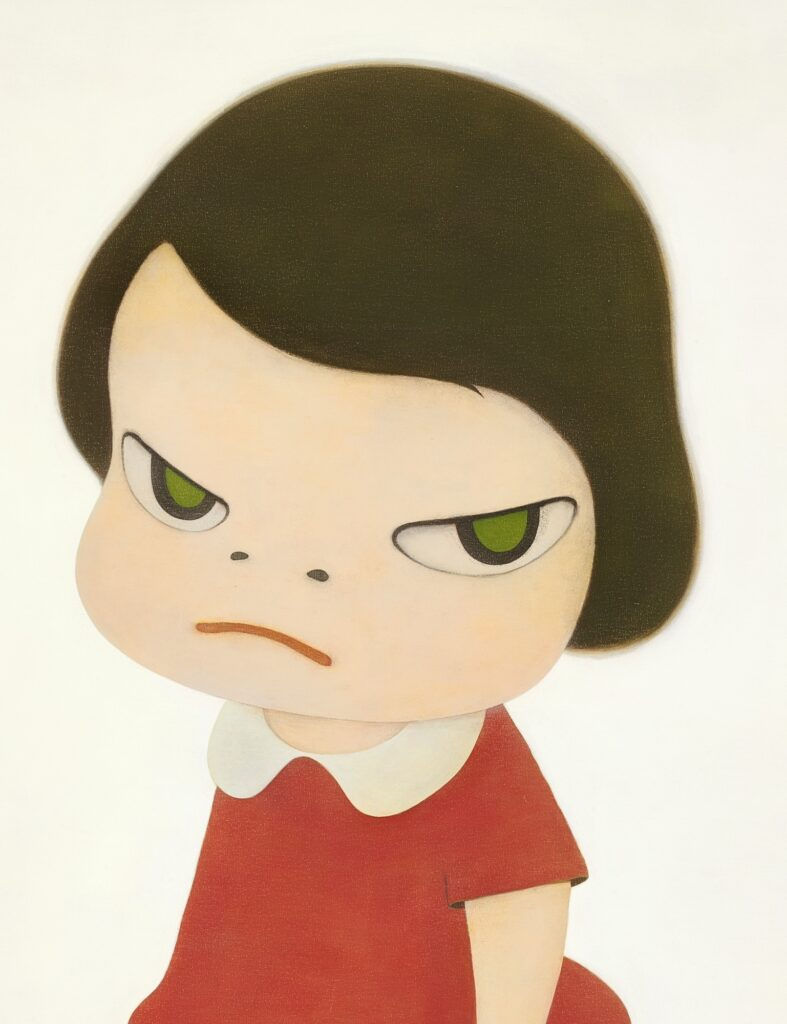
Knife Behind Back (2000), Yoshitomo Nara
This painting presents a child-like figure holding a concealed knife. The composition is minimal, with a flat background and simplified forms. Nara uses flat color fields, clean outlines, and reduced spatial depth, aligning with a naïve visual style.
The figure’s large eyes function as a focal point, emphasizing direct gaze and psychological presence. Despite the simplified form, the subject introduces tension through contrast between innocence and implied aggression.
This work reflects an early stage of Nara’s style, where emotional ambiguity emerges through controlled minimalism. The lack of environmental context isolates the figure, reinforcing a sense of internal transition.
Artwork Analysis 2

Midnight Vampire (2021), Yoshitomo Nara
In this later work, Nara maintains his signature visual language, large eyes, simplified forms, but introduces more layered surfaces and subtle tonal variation. The brushwork becomes more visible, and the background gains slight depth compared to earlier flat compositions.
The figure retains a child-like appearance but carries a more complex visual presence. The controlled simplicity remains, but there is increased refinement in surface treatment and color modulation.
This shift suggests a development in Nara’s practice: rather than changing subject matter, he deepens his technical execution while maintaining conceptual consistency.
Artistic Development
Nara’s work reflects a gradual evolution rather than a sudden transformation. In an interview, he stated:
“I don’t think my work has changed suddenly. It has been a slow process.”— Yoshitomo Nara
This reinforces the idea that artistic identity is formed over time through repetition, reflection, and experience.
Conclusion
By examining Nara’s work across different periods, we see that “becoming” is not a fixed moment, but an ongoing process. Both personal identity and artistic practice develop through time, shaped by influence, discipline, and gradual change.
Rather than asking who we are, this issue asks a different question:
Who are we becoming?
References
Nara, Yoshitomo. Interview, Museum of Modern Art (MoMA).
Schimmel, Paul. Yoshitomo Nara. Los Angeles County Museum of Art, 2010.
Japan Society. Yoshitomo Nara Exhibition Materials.
Comments